Category: Tiny Houses

  • The Tiny House Archive: Celebrating the Early Years

    The Tiny House Archive: Celebrating the Early Years

    Open the Archive

    For the past 30 years, I’ve worked in technology. The last few years have been immersed in all things Applied AI, AI Ethics, and Alignment. But there was a period between 2008 and 2019 when I spent my off-hours designing tiny houses. 

    I stepped by from tiny houses in 2019, working in the technology sector by day, while continuing to design, create art, and write by night.

    I am going to return to spending some of my time in the tiny house design studio in 2026. But before I begin posting new concepts—which will focus on wider, 10-foot tiny homes and longer footprints—I wanted to do something special with the work that started it all.

    Over the next few days, I will open my tiny house design “archive” one last time. 

    The archive includes 20 tiny house plans, 4 cabin plans, and 4 ebooks on tiny house design

    If you missed these designs during my first decade of tiny house design, this is the last opportunity to add them to your collection.

    Open the Archive

  • Road Trip Gooseneck Tiny House Design Study

    Road Trip Gooseneck Tiny House Design Study

    This is a concept for a 36-foot tiny house on wheels. It has two living rooms than convert into sleeping spaces. The kitchen and bath are centrally located.

    A fold-down porch and stairs provide exterior living space but fold up for travel. The windows all have covers that provide shade when up and security and window protection when closed.

    Below are some interior renderings to show some of the transforming built-in furniture.

  • Mirrored Tiny House Concept

    Mirrored Tiny House Concept

    Call me crazy, but I really like the idea of a mirrored tiny house; but I have a lot of questions about the feasibility. What would it be like to have a mirrored tiny house? Would it blend into its surroundings or stand-out like a soar thumb? Would birds crash into it? Would it cost a fortune? Would the occupants get constantly photographed by curious onlookers?

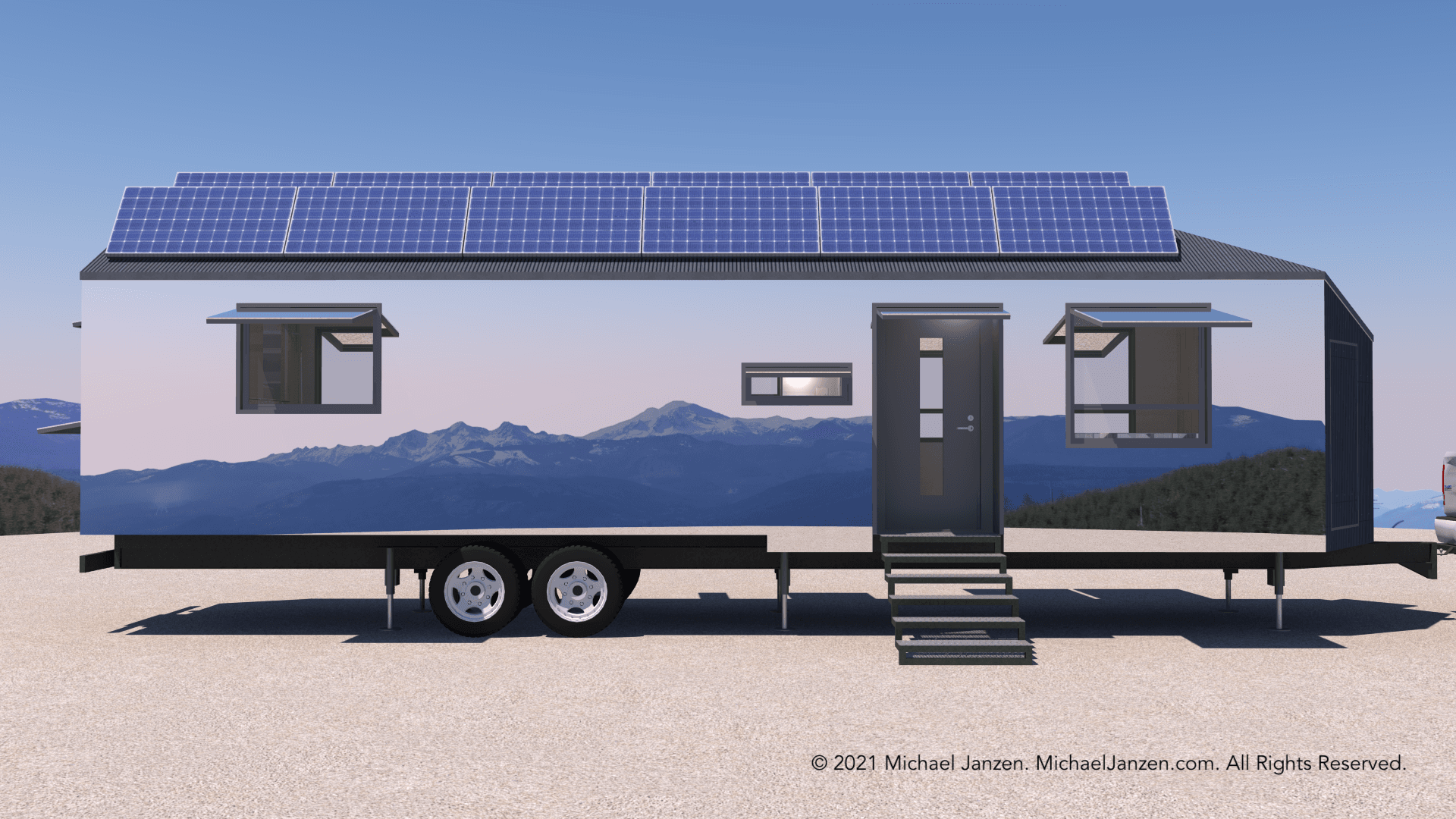
    36-foot long tiny house. Mirrored on three sides.

    This design is a simple box with a 3/12 gable roof and a slightly more aerodynamic nose than most tiny houses. The boxy shape would likely be easier to cover with mirrors. The nose and roof would be black metal roofing for durability. The roof would be covered in solar panels on mounts that tilt to the left and right.

    As you can see in these renderings the mirrors reflect the surrounding scenery nicely – much like the real photos of mirrored houses we’ve seen on the Internet. I actually think the house might just blend into the natural surroundings once parked. On the road, I bet it would be quite the eye catcher – hopefully not a distraction or difficult to see. For sure it would be a huge conversation starter and photographer magnet.

    Fold-up metal stairs fit into the front door recess. Windows have welded metal shutters that open upwards to function as awnings.
    The nose houses the water heater, propane tanks, minisplit A/C unit(s), generator, solar system and lithium batteries. Since outdoor minisplit until are meant to be mounted outside, ample venting around the unit and a vent door would need to be kept open when in use.
    Solar panels would be on frames that fold either to the left or right so that they could be tilted more toward the sun. I tried to imagine what the design of a 360-degree automatic tracking mount might look like, but kept it simple for this one.

    This tiny house design is 36-feet long on a custom trailer design with tandem dual wheel axles. The rear section of the trailer is higher to provide more space for water tanks (fresh, black and grey) under the floors of the kitchen and bathroom.

    The tiny house is ready to roll – the shutters are shown closed, the steps are folded-up and secured.

    The home’s shutters would be mounted on heavy duty self-opening spring hinges or normal hinges with gas struts for support. It would be super cool to have them on automatic opening gas struts like those found on the hatch of an SUV.

    When on the road the house closes-up to keep things safe and aerodynamic. You could also close the house up when in camp to help secure it from would-be thieves. The nose of the house is angled and protrudes over the trailer tongue to provide space for utility gear and an aerodynamic nose into the wind.

    You are now inside the Living Room looking back to the kitchen and bunk room in the back. A small eating counter with two stools provide a place for a quick bite or chat with the cook.
    View from the kitchen looking into the living room. The kitchen is fairly large with an oven, induction stove top, microwave, full-size built-in refrigerator, double sink, and a lot of counter and cabinet space.
    Washed dishes would be placed in the rack above the sink to dry.
    The living room doubles as a dining room.
    The table shown folded up.

    A television, stereo, and minisplit A/C head are hidden away behind the folded-up table. The minisplit would not be functional with the table up, and is hidden above the stereo behind the wood slats. There are three other minisplit head location shown in the floor plan at the bottom of the story.

    Living room in night mode.

    The sofas are on castor wheels and can be rolled together to form a bed. The bed can be centered off to one side. The sofas have three storage drawers each to provide clothing storage. The shutters or roll-up blinds could be closed for privacy at night.

    A bunk bed built for privacy could be constructed for kids, teens, or adults.

    The bunk bed length is over seven feet. Bed width is over three feet, so standard twin mattress could fit in each bunk. Simple sliding doors shut when privacy is needed. Opening windows in the bunks provide light, ventilation, and egress in an emergency. A small loveseat sized sofa and a fold-up desk provide more function to the bunk room.

    Small Bathroom with 36-inch square shower.

    The bathroom is accessed from a hall that separates the kitchen from the bunk room. A swinging door would be used for the bathroom so towels could be hung to dry on a towel bar on the door. Across the hallway from the bathroom is ample storage and full height closets for four people.

    Floor Plan. Bunk room on the left. Bathroom, hallway with closets between the kitchen and bunk room. On the right is the living room that can also be used as a bedroom or dining room.

    Pocket doors separate the bunk room from the hallway and bathroom, and the bathroom and hallway from the kitchen. The kitchen and living room stay open to each other. There is no loft in order to keep the ground clearance of the trailer high and the roofline under 13-feet so the house could be taken on an Alaskan or Canadian ferry adventure.

    This is a tiny house designed to travel with a family of four. It’s off-grid setup could be configured to be large enough to keep it cool in Arizona or warm in Alaska. A backup propane powered generator could be mounted in the nose to provide extra power on dark says. There’s plenty of space for large RV water and grey & black tanks so that you can stay for a week or two at a time in off-grid boondocking campsites.

    I think the best mirrored material for the exterior would be mirrored polycarbonate, but it is very expensive and I’m not sure about its durability. Polished stainless steel would be much more durable, but if it is not perfectly flat a funhouse mirror effect seems to occur. Glass probably provides the best mirror surface, but would likely be the most expensive and would be more susceptible to breakage than polycarbonate. One thing is for sure, the owner of a mirrored tiny house would be washing it all the time to keep it shiny and clean.

    Mirroring aside… I really like this floor plan. I think it would be ideal for a traveling family. The parents would use the living room as their bedroom at night and the kids (even teenagers) could be comfortable in the bunk room at night.

    What do you think about this design? What do you think of a mirrored tiny house?

  • Road Trip Jeep Hauling Tiny House Concept

    Road Trip Jeep Hauling Tiny House Concept

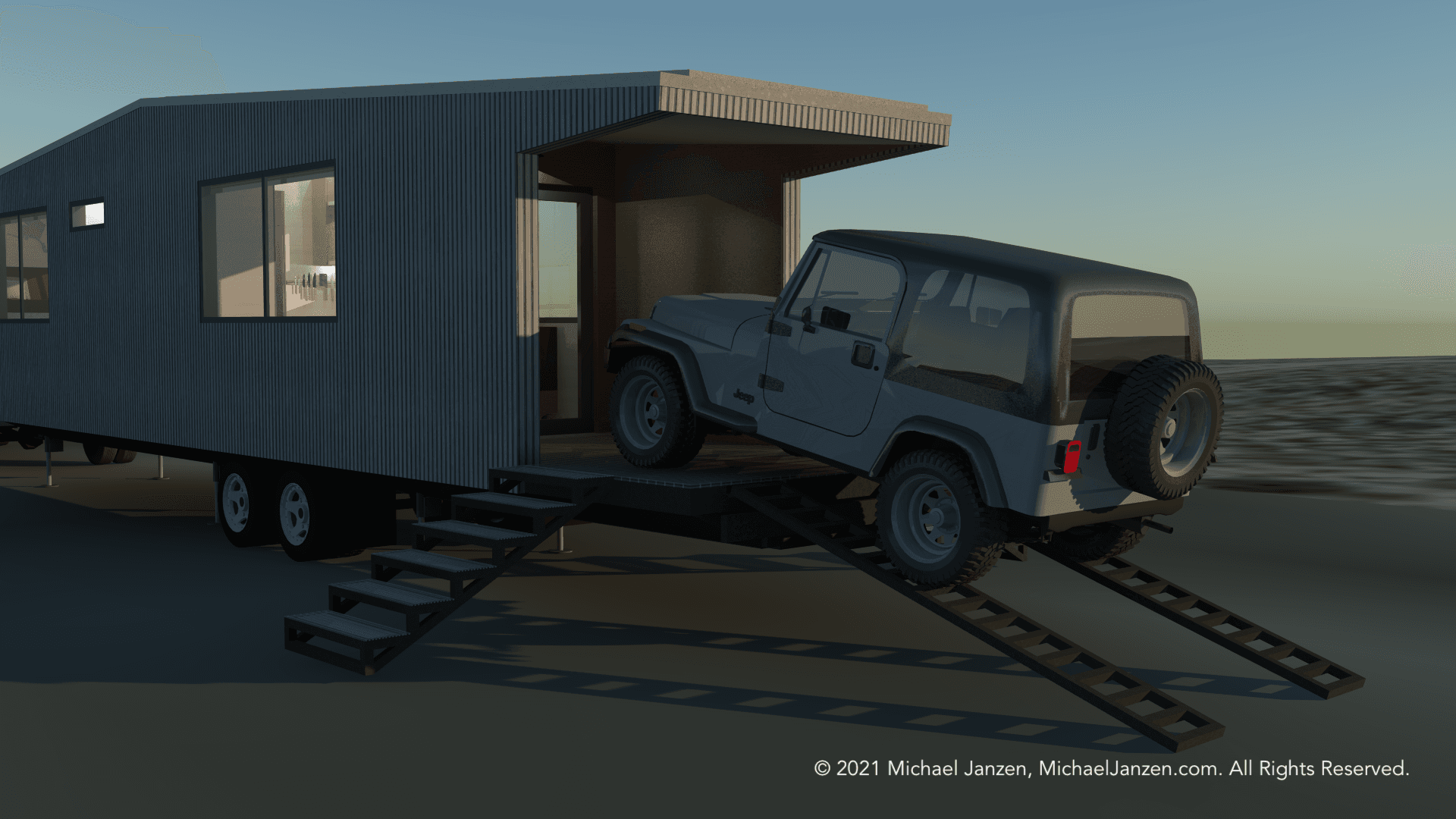
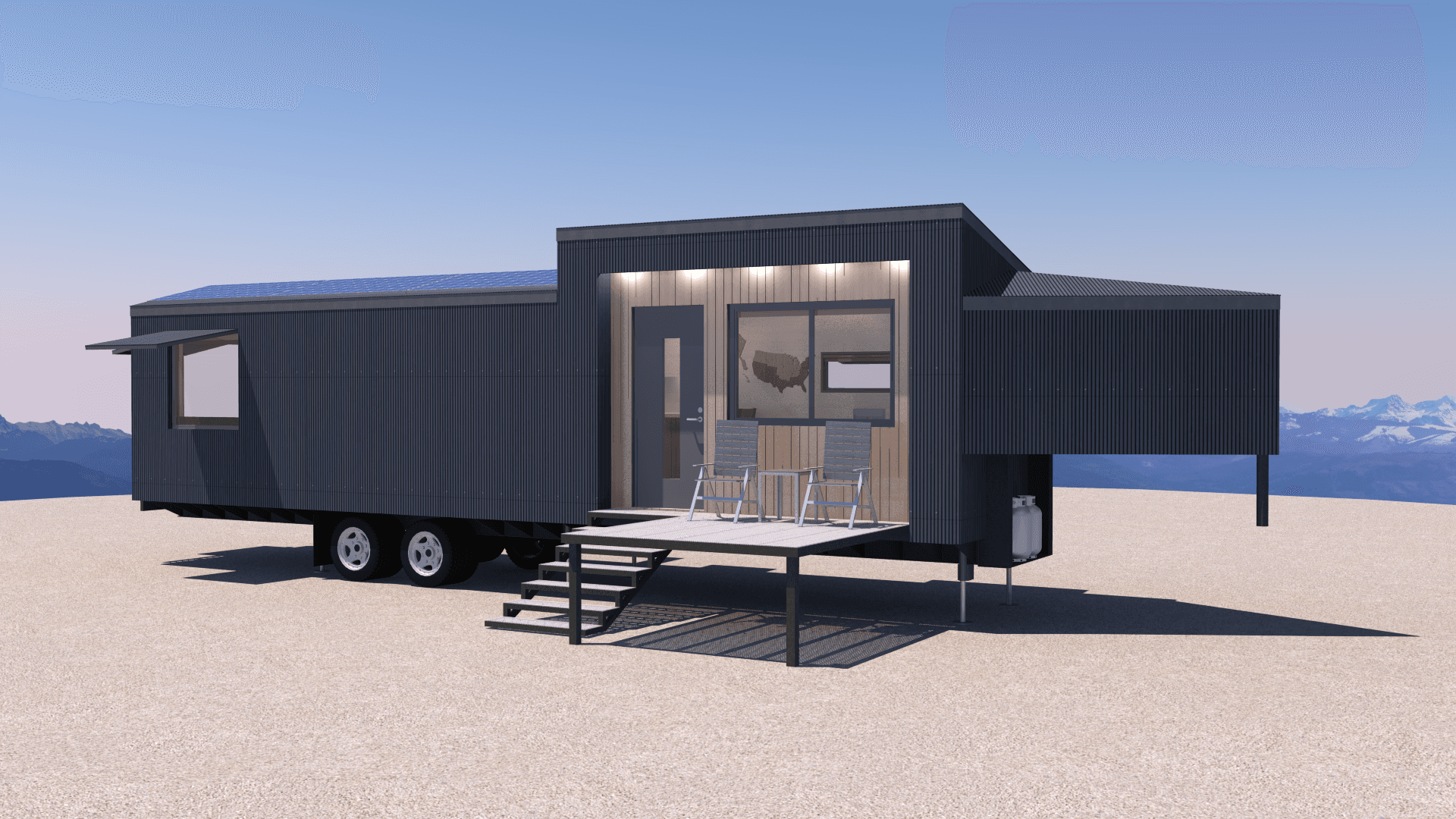
    Drive your Jeep right up onto the 11′ 9″ deep porch when ready to hit the road.

    This is a design idea I’ve been playing with a lot lately. Most tiny houses don’t travel well because they are heavy, brick-shaped, and built to maximize the building envelope defined by the size limitations of 8.5-feet wide and 13.5′-tall. So most tiny houses ride low, drag their butts on steep driveways, and are not usually very aerodynamic. This design is different.

    A dramatic entrance welcomes you home. The porch surface would be a steel grate strong enough for a 4,000-pound Jeep, would scrape the mud off your boots, and would never collect water.
    Your boondocking home is quickly setup and you’re now ready to explore the remote backwoods in your Jeep. Your giant RAM 3500 is 4-wheel-drive too, but build for highway towing. (Note to Jeep lovers… I couldn’t find a good JK or JL SketchUp drawing to add to my tiny house drawing so had to settle for this YJ. Nothing against YJs. except for the square headlights. LOL)

    I wanted to imagine a tiny house that was built to travel and explore, so I started with the trailer design. This trailer would have a 40-foot trailer bed, an 8-foot gooseneck, dual tandem wheels, 12,000-pound axles, trailer breaks, and hydraulic self-leveling jacks like a commercial fifth wheel trailer.

    The trailer would have very good ground clearance and would be much nicer to tow on a regular basis than the typical tiny house. The sacrifice is limited ceiling height due to a floor so high in the air. The ceiling is 8 to 9-feet tall, just not tall enough for a true loft. The overall height of this design is just under 13-feet so you could take it on a Ferry to Alaska if that was in your budget (most ferries I researched have limits of 13-feet tall for trailers and RVs).

    Custom trailer with high ground clearance and dual tandem 12,000 pound axles.

    Due to it’s length, a tiny house like this would likely weigh a lot, like 16,000 to 20,000 pounds with the 4,000-pound Jeep loaded on the back. One drawback of this design would be that it would be tricky to balance the trailer for towing if you were missing the Jeep counterweight.

    You just pulled into camp and ready to offload the Jeep. Lower the side stairs for easier access to the Jeep.
    The Jeep is loaded, strapped down, and your home is ready to hit the road. The stairs on both sides of the porch would be steel or aluminum and hinge-up and secured when you’re ready to travel.

    For sure it would take a heavy duty truck to tow this tiny house, like a RAM 3500, Ford F350/F450, Chevy or GMC 3500. Big trucks like that are built for highway towing, so it might be fun to travel with a Jeep for backwoods exploring, which is why I added a large porch out back that’s deep enough for a Jeep.

    It would be driven up and down on ramps just like a flatbed car-hauler trailer. When you’ve setup camps, and the Jeep is parked nearby, the porch would be a nice place out of the mud for hanging out and cooking.

    Side view shows the front room on the left, the kitchen window in the center, and the back room on the right.

    The shape of the home’s nose is meant to be aerodynamic, or at least more aerodynamic than the typical brick-shaped tiny house.

    Total length of trailer and truck would be just under 65-feet – which is about as long as you can go and stay legal. I believe the weight could be kept just under what a commercial driver’s license requires.

    In the center of the house is the heaviest stuff: kitchen, bathroom, pantry, clothes storage, water tanks below the floor, etc. The utility items like batteries, solar power gear, generator, and water heater would be in the nose over the gooseneck.

    This is a tiny kitchen. The 10 cubic foot 12VDC refrigerator just out of sight on the left. Three pocket doors separate the front room from the kitchen, the kitchen from the hallway (from where you access the bathroom), and the hallway from the back room. Closing these doors could provide more privacy for those using these close but separate spaces.
    Looking down at the tiny kitchen counter. It’s only 5′ 6″ wide. A microwave could be added above the induction stove and an oven could fit below – but valuable cabinet space would be sacrificed.

    The frame of the house should be steel for it’s light weight and strength. For sheathing I’d choose Huber ZIP R-Sheathing even though its a bit on the heavy side. It provides the shear strength, plus a thermal break, vapor and water barrier all-in-one. The siding and roofing should be lightweight aluminum or steel panels with furring strips behind the panels for the air gap.

    Behind the furring strips, siding and roofing should be a continuous inch or two of foam insulation for maximum insulation performance. The wall cavities should also be insulated with lightweight foam.

    I like the modern look of plywood for interior walls, so I think I’d sheath the interior with furniture grade plywood. I wouldn’t hide the seams with trim, I think that looks tacky. Instead I’d bevel the edges with a router to accentuate the joints and use nice looking fasteners. If you’re going to use plywood, be proud of it and show it off.

    12 huge 425 watt solar panels can fit on the roof for a maximum of 5,100 watts.

    Since I’m just having fun imagining the perfect traveling tiny house (and apparently on a limitless budget), it should also have a huge solar system too. The roof is big enough for 12 425 watt solar panels for a whopping 5,100 watts of power. There should also be a lithium battery bank properly sized to store all that sunlight. I’m guessing we’re talking like $15,000 to $20,000 of solar power here.

    Why so much solar? Well in that hallway between the kitchen and back room would be a full size stacked washer and dryer hidden behind cabinet doors. There should also be a two head mini-split to keep both ends of the house cool. All of that would require a huge solar system – especially if you wanted to stay cool while boondocking in the desert in your completely off-grid tiny house.

    View from the back room looking toward the kitchen, front room, and porch. Notice the mini split head unit on the wall to the right. I hate how those look, but it would be nice in a house with so many windows on a hot day. Also notice the roll-up RV blinds.
    View into the back room. The map on the wall shows where this imaginary family has traveled so far. It’s an art piece with interchangeable states stained in two different colors.

    The 7-foot sofas in the front and back room are on castors and can be pushed together to form a bed big enough for two. The sofas have three large drawers each (total of 12) for clothing storage for the whole family. The hallway has full length closets for hanging dresses and other clothes. In the back room is a small 2-foot deep loft just big enough for a young child (or hanging out and chilling). The house could sleep a maximum 4 adults and 1 child comfortably.

    Looking into the house from the front door. You can just barely see the refrigerator and cabinets on the left in the kitchen in this shot.
    Looking back toward the front door and porch beyond. A barbecue, four folding chairs, and two small folding tables are also on the porch.

    The bathroom is small, but typical for a tiny house. The shower shown is 36-inches square. The bifold glass door would allow easy access to the shower even when standing inside this small space.

    The toilet shown is mounted on the wall and has a tank located inside the wall. These toilets are a bit more expensive but can be as low flush as a typical RV toilet. The space is a bit tight for hanging towels up to dry, but adequate. There’s a window just out of view above the mirror.

    This design is actually #35 in a series of tiny houses I’ve been drawing quietly and privately. I’ve decided to take my hobby public again and will begin to share more designs here in the near future. It was drawn with SketchUp Pro 2021 and rendered with SU Podium V2.6.

    Stay tuned for more and feel free to tell me what you think in the comments.

    Floor Plan

  • 9 Key Insights from the Tiny House Movement

    9 Key Insights from the Tiny House Movement

    My journey with the tiny house movement began in 2007 when I caught Jay Shafer’s segment on Oprah. At the time, I was watching my California home’s value evaporate and coming to terms with the reality of traditional mortgages. What started as casual curiosity became a decade-long exploration that taught me valuable lessons about living intentionally.

    Here are nine key insights that anyone can apply, whether or not tiny living is their goal:

    1. Comfort Requires Less Than We Think

    After documenting countless tiny house success stories over eleven years, one truth stands out: we need remarkably little to live comfortably. The challenge isn’t adapting to smaller spaces—it’s confronting our relationship with possessions.

    I’ve come to believe that fewer possessions can lead to greater happiness. Every item we own demands attention, space, and often money. When we store things in paid units (yes, I’ve been guilty of this, too), we’re not just paying financial costs—we’re carrying the mental burden of eventually dealing with those items.

    2. Growth Comes Through Challenge

    The tiny house movement ignited my creativity in unexpected ways. I had to learn new skills to bring my ideas to life—from concrete pipe houses to nine-square-foot dwellings. Teaching myself SketchUp, a 3D modeling tool, opened doors to designing countless tiny house plans and created new income streams.

    This pattern repeats throughout the community: tiny housebuilders often become carpenters, metalworkers, videographers, and entrepreneurs. Each project becomes a catalyst for personal and professional growth.

    3. Freedom Is a Daily Choice

    Choosing simplicity in a consumption-driven world requires constant mindfulness. It’s like maintaining a healthy diet in a world of endless temptations. The conventional path—taking on a mortgage and accumulating possessions—often seems like the path of least resistance.

    True freedom requires daily recommitment to your values, especially when surrounded by different choices. The battle isn’t just external; it’s primarily in our minds.

    4. Extreme Examples Spark Innovation

    The tiny house movement demonstrates that alternatives to traditional housing and lifestyle choices exist. Each success story proves that what seems radical at first can become not just possible but desirable.

    5. DIY Housing Is Achievable

    While building a conventional home often requires professional expertise, tiny homes have made construction accessible to everyday people. The scale makes learning possible as you build, creating something personal and practical within months rather than years.

    6. Size Should Match Lifestyle

    Not everyone can—or should—live in 120 square feet. While tiny homes work beautifully for singles and minimalist couples, they can challenge larger families or those working from home. The key is finding the right balance for your specific needs while incorporating the principles of intentional living.

    7. Mobility Requires Different Solutions

    Converted buses often make more practical sense for those seeking travel than tiny houses. Their steel construction, aerodynamic design, and proven mechanical systems offer advantages over traditional tiny homes. While they might not win beauty contests, buses provide reliable, functional living spaces for nomadic lifestyles.

    8. VanLife: Ultimate Freedom vs. Space

    The vanlife movement represents perhaps the purest form of nomadic living. While space is premium, vans offer unparalleled freedom and stealth camping possibilities. It’s a lifestyle that demands extreme minimalism but rewards with maximum flexibility.

    9. The Evolution of Simple Living

    Interestingly, tiny houses have grown more luxurious over time. Early builds often cost under $25,000, while today’s models range from $75,000 to over $100,000. This trend reflects a broader truth: most people seek to balance simplicity with comfort rather than embrace extreme minimalism.

    Looking Forward

    The tiny house movement has evolved beyond size considerations into a broader conversation about intentional living. Whether in 100 or 1,000 square feet, the core principles—mindful consumption, financial freedom, and environmental consciousness—remain relevant.

    These insights have shaped my perspective on housing and lifestyle choices. As we move forward, the focus isn’t just on square footage and creating spaces that support our values and aspirations.

    Image generated with the help of AI (ChatGPT & DALL·E).