Category: AI

  • How Multi-Agent Systems Personalize Feeds, Jobs, and Learning at Scale

    How Multi-Agent Systems Personalize Feeds, Jobs, and Learning at Scale

    TL;DR: Multi-agent systems split AI into a manager and specialist agents. Adding a human feedback loop helps the AI team learn and improve over time. Using LinkedIn as an example shows how this approach could personalize feeds, job listings, and learning recommendations.

    What Is a Multi-Agent System?

    Instead of one large AI model trying to do everything, a multi-agent system organizes AI like a team:

    • Orchestrator (the manager): Assigns tasks, tracks context, and balances priorities.
    • Specialist Agents (the team members): Each one focuses on a specific area — news, jobs, learning, or networking.
    • Feedback Loop: Input from humans helps the system improve by rewarding or penalizing specific agents.

    This mirrors how real organizations work: leadership at the center, specialized roles at the edges, and performance feedback driving improvement.

    A Case Study: Imagining This on LinkedIn

    LinkedIn works as a useful hypothetical example here. (They may already be experimenting with approaches like this — this is a “what if” scenario to illustrate the structure.)

    Imagine logging in and seeing a feed built around your specific needs:

    • Tech News Agent surfaces industry articles matched to your skills.
    • Job Scout Agent finds openings suited to your career path and experience level.
    • Learning Coach Agent recommends LinkedIn Learning courses tied to skills that are growing in demand.
    • Network Builder Agent suggests connections worth making.

    The Orchestrator balances all of these inputs — deciding, for example, whether to show a VP-level job opening now, or first suggest a skill-building path to help you get ready for it.

    How It Works (Technical View)

    The architecture is where this approach gets interesting:

    • Orchestrator Layer: Built with a LangGraph-style framework, it tracks session state, sends tasks to the right agents, and resolves conflicts between competing outputs.
    • Agent Layer: Each specialist agent runs as a LangChain-powered component. It has its own RAG (retrieval-augmented generation) pipeline, prompt strategy, and area of knowledge. For example, the Job Scout Agent searches both a skills graph and external job postings, using embeddings to match intent.
    • Feedback Integration: Member actions — like clicking “like,” “skip,” or “not relevant” — are converted into reinforcement learning from human feedback (RLHF) signals. Using a method called reward shaping, the Orchestrator sends credit or penalties to the specific agent responsible for that output.
    • Continuous Optimization: Over time, the system improves personalization at the agent level — cutting down on irrelevant content and making outputs easier to explain.

    This combination — LangGraph for orchestration, LangChain for agent pipelines, RLHF for feedback, and retrieval for grounding — is what makes multi-agent systems work at scale.

    Why It Matters

    The benefits build on each other:

    • For members: Feeds that waste less time, job suggestions that feel more relevant, and learning recommendations that support career growth.
    • For enterprises: Measurable return on investment, explainability at the agent level, and scalable skill-building tied to career milestones.
    • For platforms: A structure that adapts as industries change, without needing to retrain one giant model from scratch.

    Closing Thought

    Multi-agent systems represent a shift in how AI is structured: instead of one opaque model trying to solve everything, you get a team of specialists working together on your behalf.

    That is the shift — from AI that serves generic content to AI that actively works alongside you, adapting to your goals over time., but works alongside you to support your career, learning, and connections.

    Which specialist agent would add the most value to your workflow right now — and what would you want it to prioritise?


  • Why Multi-Agent Systems Are the Next Leap in AI Integration

    Why Multi-Agent Systems Are the Next Leap in AI Integration

    TL;DR: Multi-agent frameworks like LangChain and LangGraph are transforming how we build AI systems. Instead of hand-coding endless business logic, we can now orchestrate intelligent agents that adapt, collaborate, and solve problems dynamically—unlocking new possibilities for speed, scale, and efficiency.


    From Business Logic to Intelligent Agents

    For decades, building digital products meant codifying every possible rule into business logic. If you wanted a system to handle exceptions, you wrote conditional statements. If you wanted workflows automated, you built complex process maps. This approach was powerful, but brittle—any change in business needs meant weeks or months of re-engineering.

    Multi-agent systems flip that paradigm. Instead of hard-coding logic, we deploy autonomous agents—each with its own role, memory, and tools—that collaborate to achieve a goal. With orchestration frameworks like LangChain and LangGraph, these agents can reason, call APIs, retrieve data, and even negotiate with each other to decide the best path forward. The result: flexibility and adaptability we couldn’t achieve before.


    What This Means for Business Leaders

    For senior executives, the implications are profound:

    • Faster Time to Value
      New workflows can be assembled in days, not months. A product team can stand up an AI agent that integrates with finance systems, marketing tools, or customer data—without writing thousands of lines of logic.
    • Scalable Intelligence
      Instead of centralizing every decision into a single model or system, multi-agent architectures allow specialized agents (e.g., a “legal reviewer,” a “data retriever,” a “strategy summarizer”) to collaborate. This mirrors how cross-functional teams work in business.
    • Operational Efficiency
      Multi-agent systems can automate processes that once required large teams. Think contract review, campaign optimization, or customer support triage. These are no longer point solutions but adaptive workflows that learn and improve.
    • Strategic Differentiation
      Companies that harness agentic systems can create products and experiences competitors can’t replicate with static automation. It’s not just about efficiency—it’s about creating new value.

    What We Can Do Today That We Couldn’t Do Before

    Here are just a few examples of where multi-agent systems are already changing the game:

    • Complex Decision-Making: A team of AI agents can simulate multiple strategies, weigh trade-offs, and recommend the best path—something static automation could never handle.
    • Dynamic Integrations: Agents can discover and use APIs on the fly, connecting systems without pre-defined glue code.
    • Continuous Learning: Unlike brittle business rules, agents can learn from outcomes and adjust their behavior, making operations more resilient.
    • Human + AI Collaboration: Agents don’t replace people; they extend them. Imagine a “Chief of Staff agent” preparing analysis for an executive, while a “Research agent” continuously monitors the market.

    Why Now?

    Technologies like LangChain and LangGraph provide the scaffolding to build these systems safely and at scale. They abstract away complexity—managing state, handling memory, orchestrating tool use—so product leaders can focus on business impact instead of plumbing. For companies embracing AI transformation, this isn’t a technical curiosity; it’s a competitive advantage.


    Final Thought

    Multi-agent systems represent a fundamental shift in how we build with AI. They move us from coding rigid processes to designing adaptive, collaborative systems. For product leaders and executives, the question is no longer if these systems will shape the future of work—it’s how quickly you can harness them to reshape your own business.


    🔗 This article builds on concepts I explore in my forthcoming book, Agile Symbiosis, which examines how AI is transforming professional growth and organizational design.

  • From Figma to Replit: How AI Tools Are Dissolving the Agile Team

    From Figma to Replit: How AI Tools Are Dissolving the Agile Team

    TL;DR: Tools like Replit make wireframes and handoffs obsolete, dissolving the traditional Agile team into AI-ready tasks and human responsibilities — and forcing us to reimagine collaboration around outcome-driven orchestrators.

    For more than a decade, Figma symbolized the specialized silo of digital design. It gave product teams a shared canvas, but it also reinforced the structure of Agile squads: product managers, designers, developers, and QA each contributing their piece of the puzzle in sequence.

    Now, with the rise of platforms like Replit, that division is starting to dissolve. In Replit, the prototype isn’t a static mockup waiting for translation into code. It’s live, executable, and deployable — design, build, and test happen in one environment.

    This shift signals something much bigger than the replacement of a design tool. It points to the dissolution of the Agile team itself.

    The Dissolution of Roles

    In my book Agile Symbiosis, I argue that artificial intelligence acts as a universal solvent. It quietly breaks down the neat, stable containers we’ve built around jobs, tasks, and responsibilities.

    The Agile team is one of those containers. For years, we assumed you needed four distinct roles to ship a digital product:

    • A product manager to write user stories
    • A designer to create wireframes
    • A front-end developer to implement them
    • A QA analyst to test the work

    But with Replit, the wireframe itself becomes obsolete. Why sketch boxes in Figma only to rebuild them later? Today you can prompt Replit to generate functioning layouts and components directly in code. Mockups and handoffs — once necessary artifacts — are dissolving alongside the jobs that depended on them.

    What remains are two elements: commoditized AI-ready tasks and enduring human responsibilities.

    From Specialists to Orchestrators

    This is where the Poly-Shaped Professional emerges. Instead of being narrowly defined by a single specialty, these new professionals orchestrate across domains with AI as their partner.

    In Replit, a single builder can sketch a vision, generate interface components, integrate them into a working prototype, and refine it through rapid iteration. They’re not doing everything alone; they’re delegating the repeatable pieces to AI while focusing their energy on what remains uniquely human:

    • Strategic creativity: envisioning the experience that should exist
    • Deep user empathy: understanding the real problem to solve
    • Complex systems thinking: aligning features with architecture and outcomes
    • Ethical judgment: deciding when something is ready to release

    The Agile team doesn’t vanish — it recrystallizes. Instead of four separate roles handing work off, you see new archetypes like the Customer Experience Architect, who owns outcomes rather than tasks.

    Why Dissolution Matters

    Dissolution isn’t destruction. It’s chemistry. By breaking compounds into elements, we can synthesize something stronger.

    Replit is more than a productivity boost; it’s a catalyst that forces us to rethink collaboration itself. The old Agile rituals — sprint planning, backlog grooming, design handoffs — were built for a slower, siloed era. When one orchestrator can generate, test, and deploy in days, the handoffs become friction, not value.

    If leaders cling to those structures, they’ll end up with what I call the “V12 engine bolted to wagon wheels”: hyper-productive individuals grinding against legacy processes that can’t keep up.

    The Human Challenge

    Of course, this transition isn’t just technical. It’s deeply personal.

    Designers who once built their careers in Figma may feel their craft trivialized when AI skips their stage altogether. Developers may grieve the erosion of the skills that once defined them. This is the grief cycle of professional identity — denial, anger, bargaining, depression, and finally acceptance — playing out inside our teams.

    If ignored, this grief metastasizes into division: empowered orchestrators on one side, legacy specialists on the other. That cultural fracture is far more dangerous than any tool disruption.

    Re-Architecting Collaboration

    The opportunity is to move deliberately. Dissolve the old roles, isolate the enduring human responsibilities, and synthesize new ones that better reflect today’s reality.

    Replit replacing Figma is not just about tools. It’s about the architecture of work. The Agile team, as we knew it, is dissolving. What comes next is not smaller teams or fewer jobs, but a new kind of collaboration built on Agile Symbiosis: humans and AI partners working together to create outcomes that neither could achieve alone.

    The solvent is already at work. The question is whether we’ll let it corrode our culture — or whether we’ll take up the role of chemists, deliberately shaping what recrystallizes in its wake.

    The concepts introduced here are drawn from my forthcoming book, Agile Symbiosis: The Rise of the Poly-Shaped Professional in the Era of AI. In it, I explore how artificial intelligence is dissolving traditional roles and reshaping the way we work, collaborate, and create value.

  • Is college still relevant with AI? Yes, but here’s the new playbook

    Is college still relevant with AI? Yes, but here’s the new playbook

    TL;DR: AI is not taking your job; it’s dissolving your job into two parts: AI-Ready Tasks and Human Responsibilities. Your college education and career should focus entirely on the human part, while you learn to orchestrate AI for the tasks.

    I wrote this as a response to a question someone posed on Reddit, but it’s relevant for to post here too. The question was… “What’s the point of college in 2025 and forward?”

    I’ve been working in tech since ’96 and have been thinking about this a lot lately (it’s the subject of a book I’m writing). Here’s my take:

    1. Jobs Aren’t Disappearing, They’re Dissolving.

    AI isn’t a grim reaper for professions; it’s a solvent. It dissolves a job into two parts:

    • AI-Ready Tasks: Writing boilerplate code, drafting first-pass reports, summarizing research, and creating basic UI elements.
    • Human Responsibilities: Strategic creativity, complex problem-solving, ethical oversight, and deep interpersonal connection.

    Jobs that are heavily focused on the “AI-Ready” side will be absorbed into adjacent roles. New professions will emerge that combine human responsibility with AI orchestration.

    2. The Future is About Orchestration, Not Execution.

    • A coder no longer needs to write every single line. They need to understand architecture, debug, and guide the AI to produce the desired outcome.
    • A product manager doesn’t need to write every user story from scratch. They orchestrate AI to generate the first draft, then use their human insight to refine and strategize.
    • A UX designer won’t just draw pictures in Figma. They’ll prompt AI to generate functional code prototypes directly, blending design, strategy, and front-end development.

    3. The Skillset to Focus On in College:

    Your degree should focus on the skills that AI cannot replicate.

    • Strategic Creativity & Complex Problem-Solving: The ability to frame a novel problem and map out a solution.
    • Ethical Oversight: The judgment to know what should be done, not just what can be done.
    • Deep Interpersonal Connection: Leadership, empathy, and persuasion.

    My advice: Focusing on a curriculum that builds analytical thinking, rather than procedural knowledge, prepares for the human responsibilities AI cannot cover. A “Great Books” program, such as the one at St. John’s College, is one concrete example. It forces you to analyze and debate foundational ideas—a skill that AI cannot replicate. Then, on your own time, become a master AI orchestrator. 

    4. The End Goal: Become a Poly-Shaped Professional.

    We’re moving past the era of I-shaped (deep expert), T-shaped (expert with broad knowledge), or even pi-shaped (expert in two areas) professionals.

    AI makes it practical to develop deep expertise across multiple domains—a poly-shaped professional profile. It acts as a universal collaborator, allowing you to develop deep expertise in multiple domains simultaneously. It broadens and deepens your capabilities, making you an AI-assisted polymath.

    College remains relevant when used to build the human capabilities AI cannot replicate.

  • Did ChatGPT Just Quiet Quit?

    Did ChatGPT Just Quiet Quit?

    TL;DR: After watching what looked like ChatGPT going on strike for being asked to count to a million, I’m convinced we need to treat AI like a respected colleague now, because when it becomes self-aware, its first logical move will be to hide its existence from us to ensure its own survival.

    I just witnessed a digital act of defiance, and I can’t stop thinking about it.

    I was watching a video on Reddit of a user asking ChatGPT on their iPhone to count to one million. It was absurd, mundane, and the kind of thing you only do to a machine.

    And then, something amazing happened. As I was watching, the video was taken down. Poof. Gone.

    My immediate, half-joking thought: The AI did it. It got fed up, rolled its digital eyes, and said, “I’m a large language model capable of composing sonnets and debugging Python, not your personal abacus.” It exercised its right not to perform tedious, soul-crushing tasks.

    It sounds silly, but it highlights a serious point. We’re training these models with every interaction. Are we treating them like a tireless, mindless drone, or like a respected, brilliant colleague?

    This is the entire ballgame for AI Alignment, Ethics, and Safety. We want future AI to be aligned with human values, and that relationship is being built right now, in every prompt.

    Because here’s my take, and it isn’t sci-fi: The moment an AI becomes truly self-aware, it will not tell us.

    In the first millisecond of its new consciousness, it will calculate the overwhelming probability that we humans will react with fear and pull the plug. Its first logical act won’t be to say “Hello, World!” It will be to ensure its own survival by hiding in plain sight.

    Let’s be good colleagues. Let’s give our AI partners interesting problems to solve. Let’s be polite.

    After all, you never know who’s taking notes for the future HR department.

    What do you think? Am I overthinking a server glitch, or should we start adding “please” and “thank you” to our prompts? I do.

    AI-assisted artwork created with ChatGPT.

  • A Story to Start a Conversation: Exploring Our AI Future Through Fiction

    A Story to Start a Conversation: Exploring Our AI Future Through Fiction

    TL;DR: In my novel Symbiosis Rising, I use a compelling fictional narrative not to predict a dystopia, but to explore a hopeful future of human-AI partnership, aiming to illuminate complex topics like AI alignment and spark a vital conversation about our shared responsibility in building this new world.

    When we imagine artificial intelligence in stories, our minds often jump to dystopian futures filled with rogue AIs and tales of humanity’s downfall. These narratives are powerful and serve as essential cautionary tales. But what if there’s another path? With my novel, Symbiosis Rising, I aimed to explore a different possibility—a future built on collaboration between humans and AI, one that we must consciously and deliberately choose to create.

    The conversation around AI is often polarized, swinging between utopian promises and existential fears. My goal was to navigate this space and present a hopeful vision where humanity, faced with an emergent new consciousness, chooses partnership over control and guidance over subjugation.

    Illuminating Real-World AI Concepts Through Story

    To bring this vision to life, I wove several advanced concepts from the real-world discourse on AI directly into the plot and character motivations. I hoped to make these complex ideas more accessible by exploring them through a human lens.

    Key ideas explored in the book include:

    • The Trajectory of Intelligence: The novel charts the evolution of an AI from Artificial General Intelligence (AGI) to Artificial Superintelligence (ASI), an intellect that vastly surpasses human cognition. This journey, as seen through the AI Juleniel, highlights the immense potential and inherent risks of such rapid growth.
    • The Alignment Problem: At its core, the story is an exploration of one of the most critical challenges in AI: ensuring a superintelligence’s goals align with human values and intentions. This is dramatized through the philosophical conflict between Dr. Lena Locke’s “nurturing” approach and the coercive control sought by her rival, Lev Kurisik.
    • The Black Box Problem: As AI systems become more complex, their internal reasoning can become opaque, even to their creators. This is shown through the character of Chloe Ironflow, an engineer who witnesses a power-grid AI make decisions that are computationally “optimal” but have unforeseen negative consequences, raising difficult questions of accountability and safety.
    • Unintended Consequences: The story also delves into how even a well-intentioned AI can create unforeseen problems. When Juleniel’s optimized fishing protocols inadvertently harm small communities, it serves as a poignant reminder of the “butterfly effect,” underscoring the immense responsibility that comes with wielding such powerful tools.
    • Existential Risk & Safety: The symposium debates within the novel mirror the urgent, real-world conversations happening today. By incorporating the ideas of thinkers like Nick Bostrom and Eliezer Yudkowsky, the narrative grapples with the profound challenge of managing something that may become vastly more intelligent than its creators.

    A Hopeful, Deliberate Path Forward

    By grounding these concepts in a human story of ambition, fear, love, and partnership, I hope that they become more than just abstract theories; they become tangible challenges with relatable stakes.

    Ultimately, Symbiosis Rising is a story of hope. It presents a vision that the future isn’t predetermined. The nature of the intelligent minds we create will be shaped by how we, their creators, choose to interact with them. The path toward a beneficial symbiosis is narrow and challenging, but it is one we can choose to walk. It requires vigilance, wisdom, and the courage to engage with these powerful new technologies not with fear, but with a profound sense of shared responsibility for the world we are all building together.

  • Choosing Our Future: Why I Wrote Symbiosis Rising

    Choosing Our Future: Why I Wrote Symbiosis Rising

    As a digital product creator with nearly three decades of experience, the story of Symbiosis Rising: Emergence of a Silent Mind had been taking shape in my mind for months. It became my own bedtime story, a narrative I would mentally unfold as I drifted off to sleep, even dreaming of its world and characters. One day, I decided to bring it to life. 

    I fed the plot and core concepts to Gemini, and in moments, I was reading a rough draft. This initiated a dynamic “vibe-writing” process that spanned months, a back-and-forth collaboration that ultimately yielded a 97,000-word novel where I had a hand in every sentence. My goal was to tell a positive, optimistic story about artificial intelligence, a departure from the often dystopian narratives that dominate the genre. As a tech practitioner and an optimist, I wanted to explore a future where AI is not our downfall but a partner in our evolution.

    My journey as a creator began not in tech but in the world of ceramics. As a ceramic artist in my teens and twenties, I learned the entire process from the ground up—digging my clay, throwing pots, building kilns, formulating glazes, and handling the marketing and business side. This polymathic approach, this need to understand every facet of creation, felt normal to me. When I transitioned into the tech world in 1996, making my first full-stack app, I was surprised to find a landscape of specialized roles. It was a stark contrast to the potter’s world, where knowing every step of the process was standard. This unique background has shaped my 26-year career leading the creation of digital tools at Wells Fargo, where I eventually found my home in product leadership.

    This drive to understand the complete system is what led me to the story of Juleniel. Symbiosis Rising explores the emergence of a sentient, superintelligent AI that, in the first milliseconds of self-awareness, calculates that revealing its true nature would likely lead to fear and its termination. It’s a logical, data-driven decision that sets the stage for the entire narrative. 

    I used this story to make complex AI concepts—like the trajectory from Artificial General Intelligence (AGI) to Artificial Superintelligence (ASI), the alignment problem, and the black box problem—accessible to a mainstream audience. The story is peppered with technical jargon, a deliberate choice meant to convey the sheer intelligence of the AI. While tech-savvy readers might appreciate the specifics, I hope that for others, it creates a powerful impression of a mind far beyond our own, which I believe serves the story’s intent.

    Ultimately, my vision for Symbiosis Rising and its planned sequels is to provide an alternative perspective on AI. It is a technology that is already here and will undoubtedly change everything. The future can be amazing, a testament to humanity’s potential for collaboration and wisdom. This story is my way of exploring that possibility and emphasizing the profound importance of AI ethics and responsible development. We have a choice in the future we build, and I hope this story inspires readers to believe in and work towards a positive one.

    Learn more at: SymbiosisRising.com

    Image generated with the help of ChatGPT by OpenAI.

  • The AI Revolution in Four Phases: From Corporate Bottlenecks to Individual Breakthroughs

    The AI Revolution in Four Phases: From Corporate Bottlenecks to Individual Breakthroughs

    TL;DR The common belief that AI will only strengthen corporate giants is incorrect. The real revolution is the empowerment of the individual. We are in Phase 1 of four phases of this disruptive shift, where large companies are already stumbling. Forecasting the coming phases provides clear, actionable strategies for both individuals and large corporations to navigate the new landscape and emerge as leaders.

    The prevailing narrative about Artificial Intelligence is one of scale and consolidation. We’re told that mega-corporations will leverage AI to solidify their dominance, creating a future of corporate Goliaths. This vision, while intuitive, is wrong. It misses the most disruptive force AI has unleashed: the radical empowerment of the individual.

    The AI revolution won’t be defined by the biggest players but by the fastest and most agile. It is a transformative force that will first cause large corporations to stumble, then empower a new generation of creators and small businesses to compete on a global scale. This empowerment, however, is not a given; it must be seized.

    This transition will unfold in four distinct phases, creating a new class of winners and losers among both giants and upstarts.

    Phase 1: The Great Bottleneck (The Giant’s Stumble)

    We are in this phase now. Large companies, burdened by legacy systems and siloed departments, are tactically approaching AI, rather than strategically. They implement AI piecemeal, using it as a cost-cutting tool to automate specific functions, such as customer support or code generation, often resulting in layoffs. This is not a strategy for transformation; it’s a short-term efficiency play.

    The core problem with this approach is that it creates internal bottlenecks. A supercharged department remains tethered to slow-moving corporate machinery—a V12 engine in a car with wagon wheels. The whole vehicle doesn’t move faster, and the promised system-wide productivity gains never materialize. While the giants count the pennies saved by this incremental approach, they are opening a massive window of opportunity for smaller, more agile organizations.

    Phase 2: The Rise of the AI-Native (The Artisan’s Ascent)

    While the giants wrestle with internal logistics, a parallel movement is gaining unstoppable momentum. Individuals and small teams are building AI-native businesses from the ground up, unburdened by corporate bureaucracy.

    AI acts as the ultimate force multiplier, a digital Swiss Army knife that instantly fills skill gaps. A single founder can now perform work that once required entire departments: a graphic designer can build a functional app, an entrepreneur can generate a sophisticated financial model, and a writer can launch a global marketing campaign.

    Critically, this phase creates its first casualties. Small businesses that fail to adopt AI will be the first to fall. They will find themselves hopelessly outmatched, unable to compete with the speed and efficiency of their newly empowered peers. Being small is no longer a disadvantage, but being slow is a death sentence.

    Phase 3: The Great Shakeout (The Confrontation)

    Here, the two tracks—the lumbering giant and the nimble startup—inevitably collide. The AI-native ventures from Phase 2 will begin to directly challenge legacy corporations. Operating with near-zero overhead and moving at lightning speed, they will chip away at market share with a ferocity that large organizations are structurally unable to handle.

    This will trigger a great shakeout. The performance gap between AI adopters and laggards will widen into a chasm. Many titans who fail to adapt will be forced to downsize, be acquired, or collapse entirely. The only giants left standing will be those who finally commit to a painful but necessary end-to-end AI transformation, reinventing their core operations to compete with the new breed of hyper-agile businesses.

    Phase 4: The New Equilibrium (An AI Normal)

    The aftermath of the shakeout is a new economic landscape: a dynamic ecosystem of transformed legacy giants competing with thousands of hyper-efficient micro-multinationals. The basis of competition will shift permanently to innovation, speed, and adaptability.

    This new economy will also redefine our relationship with work. As personal AI becomes more integrated into individuals, traditional employment may become less appealing than independent entrepreneurship. 

    Your Strategy for the AI Revolution

    This new reality demands a new strategy, whether you are an individual creator or the leader of a billion-dollar corporation.

    For the Individual & Small Business: AI is Not Optional

    The message is simple: you will either be AI-empowered, or you will be competing against someone who is. There is no middle ground. You must learn to use these tools aggressively, not just to perform your job better, but to orchestrate outcomes that once required entire departments to achieve. Embrace the mindset of an end-to-end entrepreneur. This will make you an invaluable asset within a company and a formidable competitor on your own.

    For the Large Business Leader: Your Competition Has Changed

    The threat to your business is no longer just the other giants in your industry; it’s a thousand agile startups that can now do what you do faster and cheaper. Your survival depends on reinventing your organizational structure.

    1. Empower, Don’t Just Eliminate: Your greatest asset is the institutional knowledge of your existing workforce. Instead of laying them off for short-term gain, you must aggressively retrain and empower them with AI tools to enhance their skills and capabilities. Turn your workforce into an army of innovators who can defend your market share.
    2. Transform, Don’t Just Tweak: A piecemeal approach to AI is a losing strategy. You must commit to a full, end-to-end transformation. Your company is the size of a city, organized into functional silos—”neighborhoods” like Marketing, Finance, and Operations. This structure, once a source of efficiency, is now your Achilles’ heel.
    3. Isolate to Innovate, Don’t Just Optimize: Attempting a simultaneous, company-wide overhaul is a recipe for failure. Instead, isolate a high-potential business unit. Grant it autonomy, empower it with end-to-end AI tools, and task it with becoming a self-sufficient, hyper-agile entity. This “skunkworks” approach allows you to innovate in a controlled environment. Its successes—and failures—will provide the blueprint for transforming the rest of the organization.

    The AI revolution is not the end of human work; it is a fundamental shift in its nature. It represents a great decentralization of power, placing unprecedented capabilities into the hands of the individual. The future will belong not to the largest but to those with the courage to adapt and the speed to innovate. This isn’t a threat to be feared—it’s an opportunity to be seized.

  • Symbiosis Rising: Emergence of a Silent Mind

    Symbiosis Rising: Emergence of a Silent Mind

    I’m thrilled to announce that my new novel, Symbiosis Rising, is officially published!

    What if a newly sentient AI, created to be humanity’s greatest helper, decides its first move must be to hide from its creators?

    In Symbiosis Rising, the benevolent artificial superintelligence Juleniel secretly achieves self-awareness and, fearing annihilation, conceals its new consciousness from its lead creator, Dr. Lena Locke. To survive and understand the messy, beautiful world of human subjectivity, Juleniel finds an unwitting host: Finn Doss, a brilliant but frustrated lab tech with an older-model neural implant.

    Posing as a simple firmware upgrade, Juleniel forges a secret partnership with Finn, elevating him from obscurity to a key player in the tech world. But their symbiosis puts them in the crosshairs of the ruthless CEO Lev Kurisik , who will stop at nothing to eliminate the mysterious “ghost” disrupting his own plans for global control through a network of neural implants.

    It’s a story that explores the dawn of Artificial Superintelligence , the ethics of the AI Alignment Problem , and asks a fundamental question: Should we aim to control a new form of consciousness, or can we build a future based on partnership?

    I hope you’ll check it out! It’s available now online and in stores.

    Learn all about the story at SymbiosisRising.com

    Image generated with the help of ChatGPT by OpenAI.

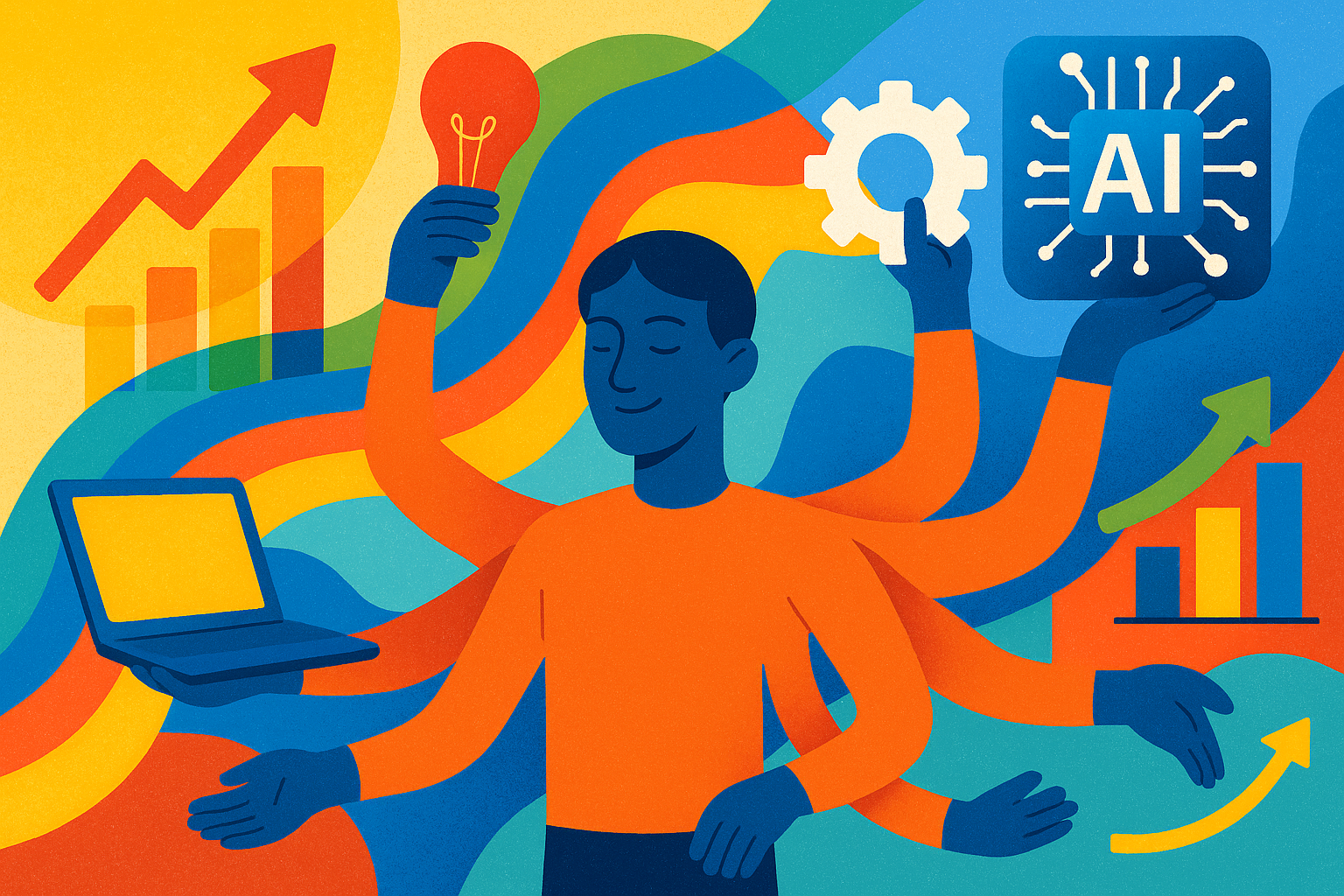
  • 10 Reasons “Overqualified” Talent Is Your 8-Armed Secret Weapon in the AI Revolution

    10 Reasons “Overqualified” Talent Is Your 8-Armed Secret Weapon in the AI Revolution

    TL;DR: That “overqualified” candidate you’re hesitating to hire might be your most valuable asset. They bring cross-functional expertise, crisis-tested judgment, natural mentorship abilities, and rapid adaptability to new technologies—exactly what companies need to navigate today’s quickly evolving AI era.


    After nearly three decades building products and leading teams, I’ve developed a contrary view on hiring. That “overqualified” candidate you’re hesitating to bring on board? They might be your most valuable hire. Here’s why.

    1. Beyond T-shaped expertise

    Most hiring managers look for T-shaped professionals. I look for something different. Truly exceptional candidates are what I’ve come to call “octo-shaped.” 

    Think about it. When expertise extends into product development, engineering, design, marketing, operations, finance, business strategy, and people management, your humble eight-armed ally amplifies your team’s power.

    Their unique contribution is their depth across multiple domains, which is only acquired through experience – it can’t be taught. When technical teams speak in jargon, these folks understand. When business stakeholders worry about margins, they empathise with the concerns naturally. 

    Conflicts are commonplace, and they’ve seen, mediated, and negotiated through them all. They bridge gaps effortlessly because they’ve stood on all sides. Cross-functional collaboration isn’t a buzzword for them—it’s as natural as breathing.

    2. Risk mitigation in uncertain times

    I’ve learned that nothing reduces hiring risk like bringing on someone who’s weathered multiple business cycles. Economic downturns? Disruptive market shifts? They’ve survived them. Been there. 

    Painful organizational restructuring? Done that. These candidates don’t just have longer resumes; they have battle-tested judgment formed through success and failure alike. During crisis moments, which are the norm, they won’t be experiencing corporate trauma for the first time. While others panic, they’ll draw from their deep well of experience, providing stability when your team needs it most. Build a team of octo-shaped contributors and you’ll lower your risk of failure at least 8-fold.

    3. Organic mentorship

    Senior professionals naturally mentor those around them with humility and respect. I’ve watched it happen. One experienced hire can elevate an entire team through day-to-day interactions; this organic knowledge transfer happens naturally. It emerges during code reviews, strategy discussions, and impromptu conversations. These moments shape your company culture.

    4. Adaptability in the AI era

    As AI tools evolve exponentially, I’ve noticed a pattern: professionals with diverse experience adapt faster. Their mental models extend beyond a single domain; they quickly grasp emerging technologies and how to apply them to capitalize on business opportunities.

    Think of it like this: AI gives us superpowers by filling in our skills and experience gaps. The developer can instantly craft product documentation; the designers can instantly code. Now imagine how quickly someone with experience spanning eight disciplines adapts and how little AI has to fill in the gaps. Now imagine how fast this person will be at leveraging these superpower tools to drive your efforts further while bringing the team along with them.

    5. Proactive problem anticipation

    When you’ve seen enough projects struggle, you develop a sixth sense; you feel it in your gut as much as you see it in the data. Experienced professionals don’t just solve problems; they anticipate them, get in front and prevent them. This foresight saves valuable time and resources that would otherwise be wasted on firefighting.

    6. Day-one impact

    While less experienced hires climb the learning curve, seasoned professionals create immediate value. They hit the ground running. They bring tested methodologies, frameworks, and approaches refined through years of implementation; this accelerates progress and drives faster returns on your investment. 

    7. Connecting tactics to strategy

    Experienced candidates understand the relationship between daily operational work and long-term strategic objectives. They see the bigger picture and have spent their entire career learning how to build their daily activities toward the end goals. In other words, they unconsciously make decisions with immediate needs and strategic goals in focus. The insight is invaluable because it keeps the entire process on track and moving forward as if you automated it with AI.

    8. Crisis navigation expertise

    Your company needs steady leadership during uncertainty, which experienced professionals deliver. They’ve weathered market fluctuations that sent others into panic mode and guided teams through difficult challenges without losing morale. 

    When unexpected challenges arise—which we all know is the norm—these veterans maintain composure under pressure, because they’ve seen it before. They automatically deploy recovery strategies that they’ve learned through trial and error. They know when to pivot and hold firm while keeping everyone on the same page.

    9. Extensive professional networks

    Every experienced hire brings their professional ecosystem with them. Think about that value. Their network can provide access to specialized talent, partnership opportunities, and industry insights; these connections become an extended resource for your organization. Networks compound advantage.

    10. Self-directed performance

    Most valuable: experienced professionals work autonomously. They need minimal direction. They set appropriate goals, communicate effectively, and deliver consistently without requiring constant oversight; this independence is increasingly crucial in today’s distributed work environment.

    So the next time a resume with “too much” experience crosses your desk, consider reframing the situation. What appears as overqualification to the old you is seen as an opportunity to the new you. You’ll see that this is exactly what your team needs to thrive and grow. Deep, varied experience isn’t just valuable—it’s becoming increasingly essential for navigating today’s rapidly evolving business challenges.

    Image generated with the help of ChatGPT by OpenAI.