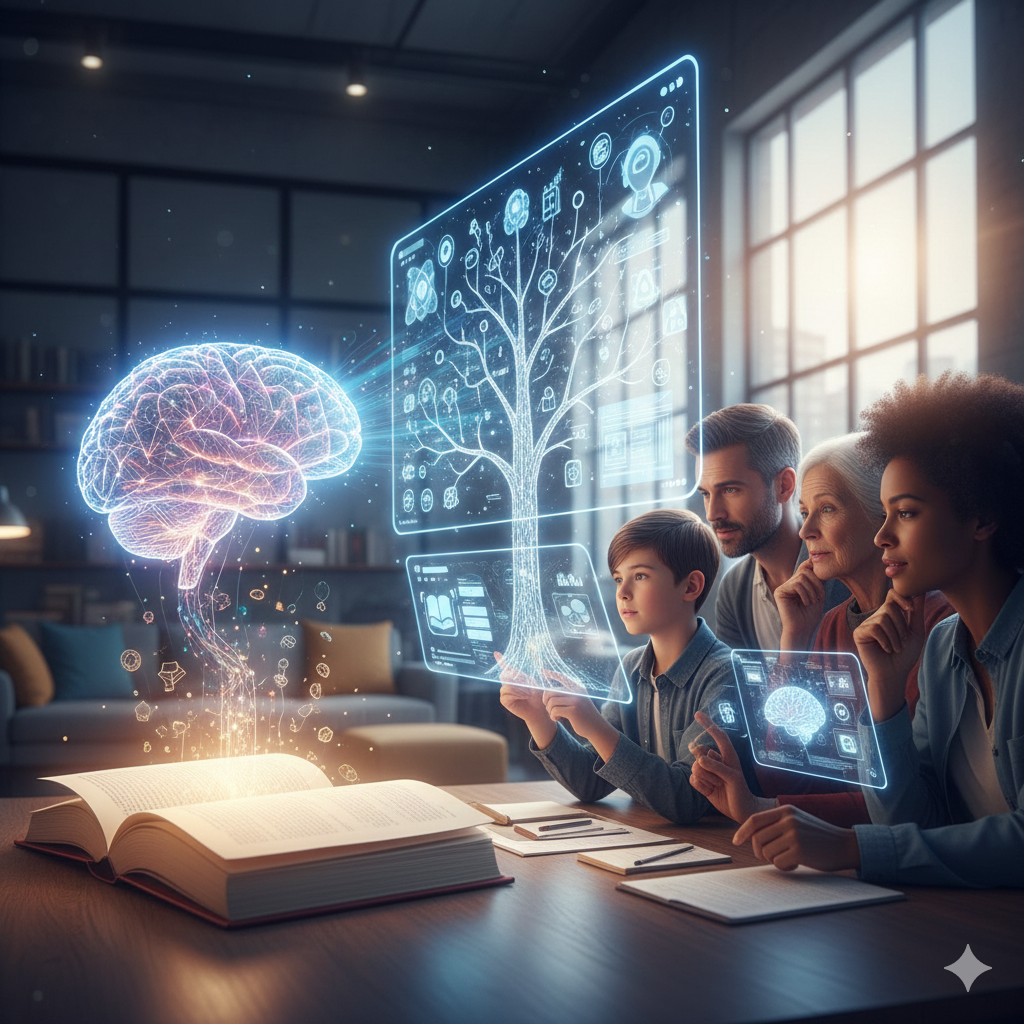
Working in Applied AI does not mean advocating for full machine autonomy — the opposite tendency is more common.
A natural process is underway. Human-AI collaboration is taking shape naturally, with silicon and carbon partners forming working relationships, each reliant on what the other provides. The D.I.S.T. framework takes shape within this context: AI systems depend on human judgment, context, and direction, while human workers draw on AI capabilities to extend what they can produce and process. But AI is not useful unless we learn to guide it to achieve human-centric goals, and to do that, we must build working relationships with AI that benefit humanity.
This is not just about the working relationship; it also deeply impacts education. Generative AI is shifting how educational tasks get completed — which roles handle them, and at what cost. Before the debate advances, it helps to examine what is concretely changing:: “jobs” are dissolving.
AI is acting as a universal solvent for knowledge work automation, systematically breaking down the stable bundles of tasks and skills we’ve traditionally called a “profession.” But dissolution is not destruction. When you dissolve a solid, you are simply releasing its elemental parts so they can be recombined into another form.
From Observation to Action
The D.I.S.T. framework (Dissolve, Isolate, Synthesize, Titrate) didn’t emerge from abstract theory but from observing how people are augmenting their work with AI. It follows a logic similar to the scientific method to help professionals—and by extension, students—navigate the transition:
- Dissolve: When we stop treating a job title as a solid block, we see it as a collection of tasks and responsibilities.
- Isolate: When we separate the Silicon (pattern-based, mechanical tasks) from the Carbon (uniquely human responsibilities), we see our value and where AI fits in.
- Synthesize: When we design new workflows where human judgment and machine execution combine, we become more adaptable.
- Titrate: When we treat these new workflows as experiments and test for accuracy, the outcomes align with human intent.
A Mindset Shift for Educators
As information becomes more readily available and a subset of cognitive tasks is offloaded to AI, our curriculum focus will likely shift, reducing information transmission while increasing symbiotic orchestration. Education shifts from the transfer of facts and knowledge to the mentorship of uniquely human strengths.
As AI augments and automates tasks for us, and we learn to use it well, what remains are the things only humans can do; three paths appear:
- Educators will spend more time focused on building those truly human skills like contextual judgment, strategic synthesis, moral accountability, ambiguity navigation, relational trust, critical thinking, ethical judgment, and learning velocity, and less time on teaching facts.
- The value of showing students how to use AI responsibly (orchestrating inputs, validating outputs) so the final outcome matches human intent becomes a priority, because without human judgment, AI outputs may remain just plausible nonsense.
- Shifting to organizational structures that support the changing landscape of what defines an area of study and profession becomes essential. Adapting to this change means more than just changing how we teach and learn; when the organizations change along with the curriculum and rubrics, the entire system adapts.
The era of the static job is ending as we offload the mechanical cognitive tasks to AI. The dissolving of the rigid containers of our professions is not one of destruction but of release.
As work is dissolved into its silicon and carbon elements, the core of human judgment and strategic intent remains the irreducible source of value. The ability to learn, synthesise, and adapt holds value that pattern-based automation does not replicate.
By preparing students to navigate change rather than experience it passively, the approach to work and education reforms alongside the technology.