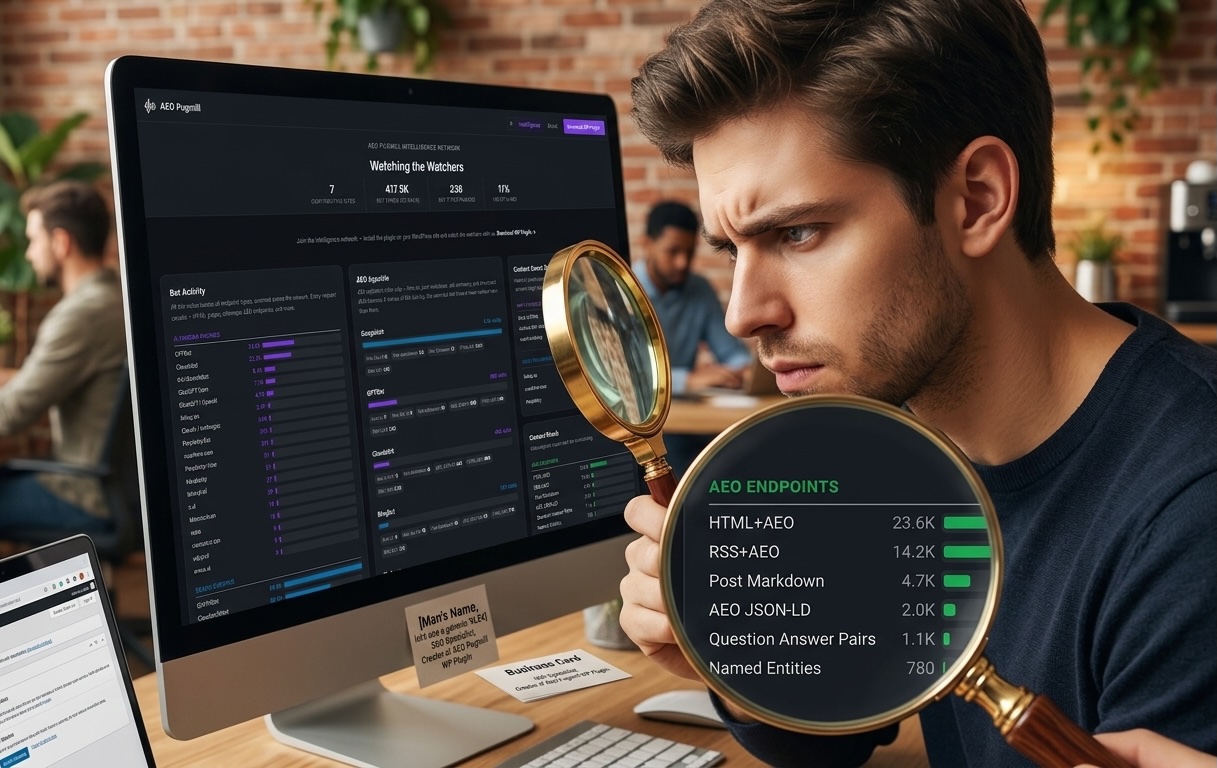
AEO Pugmill tracks how AI answer engines consume WordPress content and formats site data for those systems. AEO Pugmill operates as a network tracking how AI answer engines consume WordPress content, paired with a plugin that formats site data for these systems. AI answer engines extract and cite facts, requiring specific structuring for machine readability.
Adding the plugin to a WordPress installation generates structured data and machine-readable endpoints. Serving specific outputs as distinct URLs allows bots to request resources independently. The trackable endpoints include a plain-text llms.txt index. This index functions as a table of contents, helping crawlers determine which pages to fetch. The system produces structured Markdown renderings of individual posts. This gives bots a clean version of the text, including publication dates, summaries, entity lists, and Q&A pairs, omitting HTML markup and theme elements.
The plugin generates standalone JSON-LD files containing FAQPage schema, entity mentions, and citations. Updating the standard WordPress XML sitemap adds alternate links pointing to the Markdown endpoints. Additions to the robots.txt file signal the availability of the structured content index. Enriching the standard RSS feed incorporates AEO elements like structured summaries and named entities alongside the post content.
Embedding outputs directly into the HTML places data where search engines and crawlers expect to find it. The plugin injects FAQPage JSON-LD derived from post metadata. Entities stored in the metadata become typed mentions with links to authoritative references, assisting AI systems in disambiguating subjects. Extracting external links populates the citation JSON-LD. The plugin injects structured data derived from the post summary, falling back to the WordPress excerpt. These embedded elements register as standard HTML page requests. Separating schema into standalone files reduces utility for traditional search while providing no added benefit for AI crawlers that already parse the full page. for traditional search, while providing no added benefit for AI crawlers that already parse the full page. The distinction matters for understanding the limits of bot analytics, as parsing a specific embedded element remains indistinguishable from a full page load.
Evaluating bot activity occurs by checking incoming user-agent strings against a list of 25 recognized signatures, including GPTBot, ClaudeBot, PerplexityBot, CCBot, Bytespider, DeepSeekBot, and traditional search crawlers. Identifying a match records the canonical bot name, the requested resource type, and the date in a local daily summary table. The system does not keep a per-request log. Analyzing HTML requests captures content signals like word count brackets, freshness, fact density, and URL depth. Sharing data with the wider aggregation network is an opt-in setting. Enabling this feature transmits daily count summaries using a one-way hashed identifier, ensuring no URLs, content, or user data leave the server. When a post goes live, participating search engines receive a notification through an automated ping system that respects a 30-minute burst limit between updates.
Full architecture and technical implementation details are available at https://www.aeopugmill.com/about.
The plugin is available for WordPress installation at https://www.aeopugmill.com/plugin.